

Find the Secure AI revenue in manufacturing.
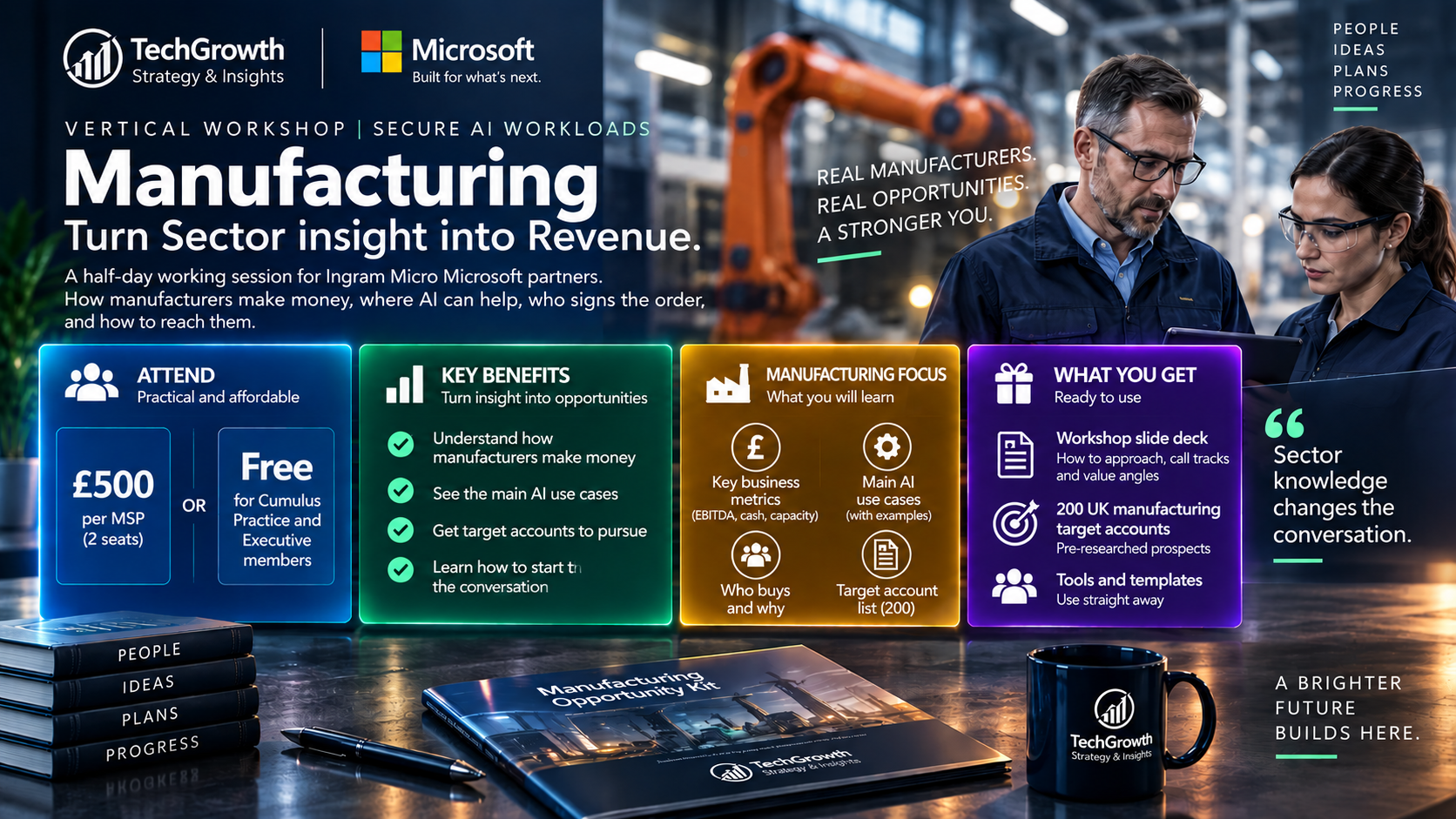
A half-day working session for Ingram Micro Microsoft partners. How manufacturers make money, where AI could help, who signs the order, and how to reach them. Included with Cumulus Practice and Executive. £500 per MSP for Community members, up to 2 seats.
Microsoft co-op funding. Subject to eligibility, you may be able to claim back up to 100% of the £500. We give you the invoice and the proof-of-execution paperwork the claim needs. Check with Ingram that you qualify before you rely on it.
You sell the same technology to every industry. You cannot sell the same business case to every industry.
The same Microsoft work sells differently to a manufacturer than to a law firm, because their money is made and lost in different places.
Most manufacturers quote a fixed price to the customer before anyone has worked out what it will cost them to build. One person quotes the work. Another prices it. The profit the job finally made sits in a different system again, and often nobody works it out.
Commercial consulting goes deep into one sector. Technology implementation works largely the same way across all of them. Both matter, and they are bought by different people.
They need measurable business outcomes.
They need IT policies and change management.
Secure AI adds a business conversation above the technical one. Neither is better. An MSP needs both, and needs to know which one it is in.
Answers: I already know Microsoft, so why do I need a manufacturing workshop? You already sell across the horizontal. This workshop builds the vertical.
This is how Cumulus reads the sector. It comes from our own model and from interviews with people who run these firms. Treat it as a pattern to test on your own customers, not a fact.
Being brought in after the business decision has already been made.
That decision gets made in a conversation about the customer’s business, not their IT. This workshop is about how to get into that conversation.
We only hear about it when they ask us to quote.
We built exactly what they asked for, but there was no next conversation.
Whoever leads the commercial conversation writes the requirement everybody else quotes against. A requirement written without you leaves you competing inside somebody else’s decision, often on scope and price rather than business value.
Three numbers a manufacturing board watches.
Most technical sales conversations do not begin with these. If yours does, you have a much stronger reason to speak with the people who own the economics.
8 to 11%
Normal profit for a mid-sized engineering firm. Below 6% and one bad year puts them in trouble.
80 to 95 days
Cash tied up in stock, in jobs not finished, and in invoices not yet paid. This is usually what stops a manufacturer growing.
75 to 82%
How much of their skilled labour is already committed. Above 85% and they have no room to take on an urgent job, and urgent jobs are usually the most profitable ones.
Five kinds of business. One method.
All five turn materials and skilled labour into a product, so one model covers them all. What changes is how each type loses money.
Which one you are in front of changes the examples, not the method.
Answers: will this cover the manufacturers I actually sell to? The worked example is engineer-to-order and batch, because that is where quoting hurts most.
The 4-Step Vertical Business Outcomes System, applied to manufacturing.
One method, applied to a different sector each month.
Know the sector
How manufacturers make money, the numbers their board watches, and where margin, capacity and cash get trapped.
Open the door
The customers you already have, the firms worth targeting, and how to get a meeting with the person who signs. This is not a cold-calling list.
Find the AI opportunity
Where AI could make them more money, free up time, or cut risk. Then how a customer moves through the four steps, starting with a free assessment.
Build the case
How the work should run afterwards, what it is worth, and how to prove it if they ask.
Know the sector → open the door → find the AI opportunity → build the case
Answers: what will the half day teach me to do? Sector knowledge, then trusted access, then a customer opportunity, then a commercial case.
Where the opportunity sits in a manufacturer.
Five places to look. They are not equal, and the biggest one is usually not where you start.
The one worth most is often the one they cannot build yet. Telling them apart is the job.
Answers: where would I actually start in a manufacturer? Finding and ranking these for one customer is what the Secure AI Business Envisioning Workshop does. Sizing the chosen one in the customer’s own numbers is what the Secure AI Business Case & Process Design does.
Who you need in the room at the customer.
These vary by sector. In manufacturing they are usually:
Owns EBITDA
And the growth plan. Ask what one point of profit is worth to them, and let them do the sum.
Owns working capital
Understands the figures faster than anyone else in the room, and will check yours.
Owns capacity, downtime and quality
Knows exactly where the hours go. Nobody ever asks them about it in money.
Owns quoting
One or two people know what a job really costs. It is written down nowhere. That is a risk to the firm, and your best way in.
How MSPs usually get ready for a sector.
All three are sensible. Here is where each one stops being enough.
You get the size of the market and the growth rate.
Your engineers learn the product properly, and usually for free.
You get a list of things AI can do, with examples.
The workshop gives you the part none of them cover. How a manufacturer makes money, where AI could help, who signs the order, and 200 firms to call.
Four things manufacturers say.
If you have sold into a manufacturer you have heard at least two of them. Each one is money, and none of them sounds like an AI problem.
We cannot start the job because the customer has not sent the information.
Estimators spend the week chasing drawings instead of pricing work.
We only find out a job overran when we come to bill it.
Someone here has done this before and nobody can find it.
Their words beat your list every time. The workshop covers what each one costs, and which of them AI can do something about.
What you leave with on the day.
The five sub-sectors, the three board numbers, and the eight processes that carry the money.
One opportunity packaged into something your team can quote.
Four roles, what each one owns, and the number each is measured on.
Up to 200 named UK manufacturers, picked to match the kind of firm the workshop covers. Enough to start booking meetings.
What to say first, and what to ask before you propose anything.
How to move a customer from a first conversation to an implementation, without asking them to commit early.
Three priced steps, then the build.
The customer only buys the next step if the last one was worth it.
- 1 Secure AI Opportunity Assessment Free. Find where Secure AI could create value.
- 2 Secure AI Business Envisioning Workshop £2,500. One day with the leadership team. Get the leadership team agreed on what matters most, which opportunity comes first, and whether to go ahead at all.
- 3 Secure AI Business Case & Process Design From £15,000. About 30 days. Size the chosen opportunity in the customer’s own numbers. Redesign the process, and create the business case and high-level solution design needed before build.
- 4 Secure AI Implementation Partner price. You complete the detailed technical design, build it, get people using it, and run it for a monthly fee.
Half a day does not make you a manufacturing consultant. It does let you open the right conversation and work out whether there is a deal in it. If a real opportunity needs deeper work, TechGrowth does the commercial side. Your customer stays yours. Steps 1 to 3 are the TechGrowth commercial layer, ending at the high-level solution design. Step 4 is the MSP technical layer: the detailed technical design, then build, deploy and integrate.
Practice and Executive members: included, nothing to pay. Community members: £500 per MSP, up to 2 seats.
Eligible partners may be able to use Microsoft co-op funding. Check eligibility and the claim route with Ingram before relying on reimbursement.
Book your MSP’s place.
Two seats are included. Add the second person now or later.
Ten sectors. One workshop a month. Manufacturing is the first.
Book Manufacturing for £500. Or join Cumulus Practice for £3,500 a year and get all ten workshops plus the complete 5P System. Ten workshops bought separately would cost £5,000.
Win the business case before you win the build.